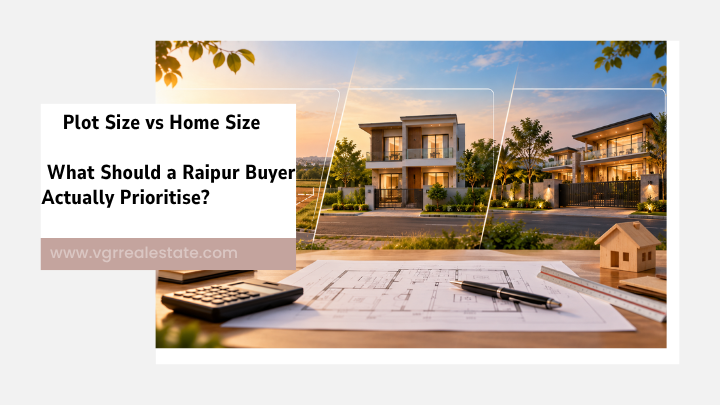

Plot Size vs Home Size: What Should a Raipur Buyer Actually Prioritise?
When buying a home, one question often creates confusion: Should you focus on getting a bigger plot or a bigger house?
It sounds simple, but there is no single answer for every buyer. A family of four may have very different requirements from a newly married couple. Someone who works from home may need more indoor space, while another family may value a garden, parking area, or open space more.
This is why looking only at the total built-up area or plot size can sometimes lead to the wrong decision.
For buyers exploring residential property in Raipur, the better approach is to understand how plot size and home size affect your daily life, future plans, budget, and flexibility. Once you understand the difference, it becomes much easier to decide what actually matters to you.
What Is the Difference Between Plot Size and Home Size?
Before comparing the two, it is important to understand what they mean.
Plot size is the total area of land on which your home can be built. It includes the space that may eventually be used for the house, parking, garden, setbacks, pathways, or other permitted uses.
Home size, on the other hand, refers to the area of the actual constructed portion of the property. Depending on the terminology used by the developer, this may be described through built-up area, carpet area, or other measurements.
A larger plot does not automatically mean a larger house. Similarly, a larger house does not necessarily mean a better property.
The real question is: Which combination works for your life?
Start With Your Lifestyle, Not the Numbers
It is easy to get attracted to numbers.
A 2,000 sq. ft. home may sound better than a 1,500 sq. ft. home. A 2,400 sq. ft. plot may sound more attractive than a 1,500 sq. ft. plot.
But numbers alone do not tell you how comfortable the property will actually feel.
Think about your daily routine.
Do you need a large living room because your family regularly hosts guests? Do you need a dedicated home office? Do your children need their own rooms? Would you like a small garden? Do you need space for two or three cars? Would you like an outdoor sitting area?
These questions can tell you more about the right property than simply comparing square footage.
When a Bigger Plot Can Make More Sense
A larger plot gives you something that a larger constructed house cannot always provide: flexibility.
You may not need to build on the entire plot immediately. Depending on local regulations and the property’s planning, additional space could potentially be used for parking, landscaping, outdoor seating, a garden, or future construction.
For families thinking long term, this can be valuable.
Imagine buying a plot when your family is small. A few years later, your requirements change. Perhaps you need another bedroom, a larger parking area, or a separate space for parents.
Having more land can give you options.
This is one reason some buyers prefer investing in a plot first and constructing a home according to their requirements.
When a Bigger Home Can Make More Sense
A larger plot is not automatically the right choice.
Some buyers need more usable indoor space today. If you have a larger family, work from home, regularly host guests, or simply prefer spacious interiors, the size and layout of the house can be more important.
For example, a family may prefer:
- Larger bedrooms
- A spacious living room
- More bathrooms
- A dedicated study or office
- A larger kitchen
- Storage areas
- A family lounge
- Better separation between private and common spaces
In such cases, spending more on land while compromising heavily on the actual home may not make sense.
The important thing is to find the right balance.
Bigger Does Not Always Mean Better
This is where many property buyers get caught up.
A bigger home can look impressive on paper, but unused space can become expensive space.
Think about a large room that is rarely used. You still paid to construct it. You may also spend more on furnishing, cleaning, cooling, maintenance, and electricity.
The same principle applies to land.
A very large plot can be attractive, but if you do not have a practical use for the additional space, you should think carefully about whether it fits your needs and budget.
The goal should not be to buy the biggest property possible.
The goal should be to buy the property that fits your life properly.
Think About Your Family Five Years From Now
One of the biggest mistakes buyers can make is planning only for today’s lifestyle.
Your requirements can change.
Children may grow older. Parents may move in. You may start working from home. You may need additional parking. You may want a garden. Your family may simply need more privacy.
This is why it is useful to imagine your life five or even ten years from now.
Ask yourself:
Will the home still work for us?
If the answer is yes, you may have found a suitable balance between plot and home size.
If you already know that your family will need additional space, choosing a property with more flexibility may be worth considering.
Don’t Forget Parking
Parking is one of those things that buyers sometimes think about too late.
A property may have a beautiful interior, but if parking two cars becomes difficult, the problem will be part of your everyday life.
Before deciding between plot size and home size, understand how many vehicles your family currently has and whether that number could change.
Also consider how visitors will park.
A slightly smaller home on a well-planned plot may sometimes offer a more practical experience if it provides comfortable parking and movement around the property.
Outdoor Space Can Change the Feel of a Home
A home is not only about indoor rooms.
A small garden, sit-out area, terrace, or open space can change how a family uses its property.
Children may have somewhere to play. Parents may have a place to sit outside. You may enjoy morning tea in an open area instead of always staying indoors.
For families who enjoy outdoor living, plot size deserves serious attention.
This is especially relevant when comparing two properties with similar home sizes but different plot dimensions.
Think About Construction Flexibility
If you are purchasing a plot with plans to build later, flexibility becomes even more important.
You may have a rough idea of your future home today, but your requirements can change before construction begins.
Perhaps you initially planned for three bedrooms but later decide you need four. Maybe you want a larger kitchen or an additional office. Maybe your parents will live with you.
A suitable plot can give you more room to adapt your future home to changing requirements, subject to applicable planning and construction rules.
This is one reason plotted residential developments can appeal to buyers who want more control over how their future home takes shape.
Location Still Matters More Than Size Alone
A common mistake is to compare properties only by size.
But where the property is located can have a major impact on everyday life.
Consider your commute, schools, hospitals, shopping, roads, public facilities, family requirements, and the overall surroundings.
A very large property that creates a difficult daily commute may not necessarily provide the lifestyle you want.
On the other hand, a reasonably sized property in a location that works well for your family may prove much more practical.
When comparing plot size and home size, always evaluate them alongside location.
Look at the Layout, Not Just the Area
Two homes with the same built-up area can feel completely different.
Why?
Because layout matters.
One property may have a large amount of space used effectively, while another may have corridors, awkward corners, or rooms that do not suit your lifestyle.
The same applies to plots.
A plot’s shape, road access, orientation, surrounding development, and permitted construction can affect how efficiently you can use it.
So when visiting a property, do not simply ask, “How many square feet?”
Ask, “How much of this space can my family actually use?”
Budget Should Guide the Decision
Your budget ultimately determines how much land and construction you can comfortably afford.
Instead of stretching your finances simply to get a bigger property, create a realistic budget first.
Consider the total cost, including the property itself and other expenses associated with registration, construction, interiors, utilities, maintenance, and future improvements.
If you are buying a plot and planning to construct later, remember that the land purchase is only the first step.
You may need funds for architectural design, approvals, construction, materials, interiors, landscaping, and other expenses.
A property that fits your budget comfortably can be more practical than one that leaves little room for future needs.
Ask Yourself These Five Questions
Before choosing between plot size and home size, answer these questions honestly:
- How many people will live in the home?
Your current family size and future plans should influence the decision.
- What spaces do we actually need?
List your priorities. Bedrooms, office, parking, garden, storage, guest room, or other spaces.
- How much outdoor space do we want?
If outdoor living matters to you, plot size deserves greater attention.
- Are we planning to construct immediately or later?
Immediate construction may require a different approach from buying land today for a future home.
- What can we comfortably afford?
Do not let the desire for a bigger property push your finances beyond a comfortable level.
These five questions can make the decision much clearer.
So, Which One Should You Prioritise?
There is no universal answer.
If your priority is future flexibility, outdoor space, parking, and the ability to design or expand your home, plot size may deserve greater attention.
If your priority is immediate indoor comfort, larger rooms, additional bedrooms, workspaces, and ready-to-use living space, home size may matter more.
For many buyers, the ideal answer is not choosing one over the other. It is finding a sensible balance between the two.
A well-sized plot with a thoughtfully planned home can give you both usable indoor space and the flexibility that comes with having land.
Conclusion
Buying a home is not a competition to find the biggest number of square feet. It is about finding a property that works for the way you live today while giving you enough flexibility for tomorrow.
For buyers exploring residential property in Raipur, comparing plot size and home size should be part of a bigger conversation about location, family requirements, layout, budget, parking, open space, and future plans.
This is also where choosing the right real estate company becomes important. A developer that focuses on planning and understands residential buyers can make it easier to evaluate how a property may fit your lifestyle.
VGR Real Estate is one company buyers in Raipur can explore when considering residential developments and plotted properties. By looking at the project, its planning, location, available property options, and overall suitability for your requirements, buyers can make a more informed decision about the kind of home they want to create.
Ultimately, the right property is not necessarily the biggest one. It is the one that gives your family the right combination of space, comfort, flexibility, and practicality for the years ahead.