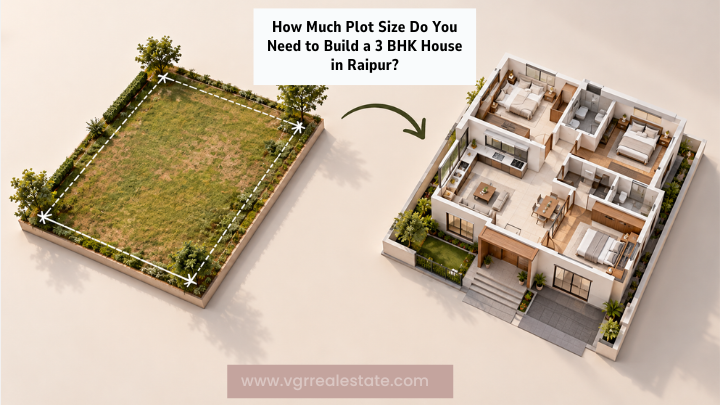

How Much Plot Size Do You Need to Build a 3 BHK House in Raipur?
Buying a plot is often the first step towards building a home of your own. But before choosing a piece of land, many families face one important question: how much plot size is actually needed to build a comfortable 3 BHK house?
Some buyers want three spacious bedrooms, while others need a home office, parking for two cars, a garden, or extra space for their parents. A plot that looks large enough on paper may feel smaller once you start planning the actual house.
If you are exploring plots in Raipur, understanding the relationship between plot size, house layout, parking, open space, and local construction rules can help you make a more informed decision.
The good news is that you do not always need a very large plot to build a practical 3 BHK home. What matters is choosing the right plot size for your family’s lifestyle and planning the available space carefully.
What Is the Ideal Plot Size for a 3 BHK House in Raipur?
For many families, a plot measuring around 1,200 to 1,800 square feet can be a useful starting point when planning a compact or moderately sized 3 BHK house. A larger plot may be preferable if you want more spacious rooms, parking for multiple vehicles, a garden, or additional outdoor space.
However, there is no single ideal size for every family. The final requirement depends on the plot dimensions, applicable building rules, required setbacks, ground coverage, number of floors, parking arrangements, and the design of the house.
For example, a 3 BHK house built across two floors may fit different requirements from a single-storey home with the same number of bedrooms.
Before deciding on a plot, think about how you want your home to function rather than focusing only on the total square footage.
1. Understand What a 3 BHK Home Actually Needs
A 3 BHK home usually includes three bedrooms, a hall, and a kitchen. But the actual space requirement depends on how you want each area to feel and function.
A practical layout may include:
- Three bedrooms for family members and guests
- A living and dining area
- A functional kitchen
- Two or more bathrooms, depending on the design
- Storage space
- A utility or washing area
- Parking, where required
- Adequate ventilation and natural light
You may also want a study room, prayer area, balcony, or a separate space for working from home.
These requirements can change the amount of space you need. A family that prefers compact bedrooms and a shared living area may need less constructed space than a family that wants large bedrooms and separate spaces for different activities.
Before buying a plot, make a list of the features that are essential and those that would simply be nice to have.
2. Plot Size and Built-Up Area Are Not the Same
This is one of the most important things to understand before purchasing land.
Suppose you are considering a plot measuring 1,500 square feet. That does not automatically mean you can construct a 1,500-square-foot house on the ground floor.
Construction may be restricted by applicable setbacks, ground coverage limits, floor-area rules, building permissions, and other local requirements.
For instance, some portions of the plot may need to remain open around the building. You may also need space for access, parking, ventilation, or other practical requirements.
This means the usable building footprint can be smaller than the total plot area.
The permitted construction area may also differ depending on the number of floors allowed and the applicable development regulations.
Therefore, before finalising a plot in Raipur, ask a qualified architect or relevant local authority to confirm what can legally and practically be built on it.
3. Is a 1,000 Square Feet Plot Enough for a 3 BHK House?
A 1,000-square-foot plot may be suitable for some compact house designs, but it requires careful planning.
If you want three bedrooms, a living area, a kitchen, bathrooms, and parking, the available space can become limited, particularly when the house is planned on a single floor.
A multi-storey design may provide more flexibility by distributing rooms across different floors, provided the plot and applicable rules permit it.
However, a compact design may involve trade-offs. Bedrooms could be smaller, outdoor space may be limited, and parking arrangements may require additional consideration.
Before choosing a smaller plot simply because it fits your budget, evaluate a sample floor plan with an architect.
The important question is not whether a 3 BHK can theoretically fit. It is whether the resulting home will be comfortable for your family.
4. When Should You Consider a 1,200 to 1,500 Square Feet Plot?
For buyers looking to balance affordability and space, this range can be worth exploring.
A plot of this size may provide a starting point for a compact or moderately sized 3 BHK home, depending on its dimensions and the applicable building regulations.
It may work particularly well for families that:
- Prefer a practical home rather than very large rooms
- Are comfortable considering a multi-storey design
- Need a manageable amount of outdoor space
- Want to balance land costs with construction expenses
- Do not require extensive landscaping or multiple parking spaces
Still, plot dimensions matter as much as the total area.
A narrow plot of 1,500 square feet can create different design challenges from a more regularly shaped plot of the same size. Room placement, staircase location, ventilation, and parking may all be affected.
Always compare the actual dimensions and not just the advertised area.
5. Would a 1,800 to 2,400 Square Feet Plot Be Better?
A larger plot can offer more flexibility when designing your home.
Depending on the layout and permissions, you may be able to plan more generous rooms, better parking arrangements, additional outdoor space, or a more spacious single-storey layout.
This range may appeal to families who want a combination of indoor comfort and outdoor usability.
For example, you might want three bedrooms, a larger living area, parking for two cars, and a small garden. A larger plot may make it easier to balance these requirements.
However, more land also means a higher purchase cost in many cases, as well as potentially greater expenses for boundary walls, landscaping, and maintenance.
Do not buy a larger plot simply because it sounds impressive. First, estimate how much space your family will actually use.
6. Should You Build a Single-Storey or Double-Storey 3 BHK Home?
Your choice of floors can significantly influence the plot size you need.
Single-storey house
A single-storey design keeps all bedrooms and common areas on one level. This can be convenient for older family members and may make everyday movement easier.
However, fitting three bedrooms, living areas, bathrooms, a kitchen, and parking onto a smaller plot can be challenging.
Double-storey house
A double-storey design distributes the home’s rooms across two floors. For example, the ground floor could contain the living area, kitchen, and one bedroom, while the upper floor contains the remaining bedrooms.
This arrangement may leave more open space at ground level, depending on the design.
However, stairs require space, and upper-floor construction adds cost. It may also be less convenient for some family members.
Neither option is automatically better. Your family’s needs, budget, plot dimensions, and construction permissions should guide the decision.
7. Do Not Forget Parking and Outdoor Space
When buyers calculate the space required for a 3 BHK house, they sometimes focus entirely on bedrooms and living areas.
But everyday life requires more than rooms.
Where will you park your car or two-wheelers? Will you need parking for visitors? Would you like a small garden, an outdoor seating area, or space for children to play?
These requirements can make a noticeable difference to your plot selection.
For example, a family that needs parking for two cars may require a different layout from a family that uses only one vehicle.
Similarly, if you want a garden, you should plan for it before construction rather than hoping that some space will remain after the house is built.
Consider these requirements early so that your plot supports the lifestyle you want.
8. Pay Attention to Plot Dimensions and Shape
Two plots with the same total area can offer very different design possibilities.
A regularly shaped plot may be easier to plan than one with unusual angles or a narrow frontage.
Before buying, check the plot’s length, width, road-facing side, access, and boundaries.
Think about where the entrance will be located, how vehicles will enter, where the staircase could go, and how bedrooms will receive natural light.
If you have a preferred house plan, ask an architect to assess whether it can fit the plot before you commit to the purchase.
This can help prevent a situation where you buy land based on its total area but later discover that the dimensions do not suit your intended design.
9. Consider Your Family’s Future Needs
A home should work for more than your current situation.
Perhaps your children are young today but will need separate rooms later. Maybe your parents may eventually live with you. You might start working from home and need a dedicated office.
Think about these possibilities before selecting a plot.
If you plan to construct the house several years after purchasing the land, consider how your requirements may change. You should also understand the current development conditions and any applicable permissions before assuming that you can expand the property in the future.
A little planning today can help you avoid expensive design changes later.
10. Calculate the Total Budget, Not Just the Plot Price
The cost of buying land is only one part of building a home.
You may also need to budget for construction materials, labour, architectural design, approvals, plumbing, electrical work, flooring, doors, windows, interiors, boundary walls, and other expenses.
The final cost will depend on the size of the house, the design, material choices, site conditions, and local construction rates.
Before purchasing a plot, create a combined budget for the land and the home you want to build.
For example, buying a larger plot may leave less money available for construction. A smaller but well-suited plot may allow you to build a more comfortable home within your overall budget.
The best choice is the one that balances land, construction, and your family’s requirements without putting unnecessary pressure on your finances.
11. Check the Rules Before Finalising a Plot in Raipur
Before making a final decision, verify the property’s documentation, land use, applicable approvals, and construction requirements.
Confirm the permitted building footprint, setbacks, number of floors, and any other rules that apply to the specific plot.
Do not rely only on verbal assurances or assume that a house design permitted on one plot will automatically be permitted on another.
An architect or qualified professional familiar with the applicable local regulations can help you understand the practical construction possibilities.
This step is particularly important if you have already decided on a particular 3 BHK layout.
Conclusion
Choosing the right plot size for a 3 BHK house in Raipur is not simply about finding the largest piece of land within your budget. It is about understanding how much space your family needs, what type of home you want to build, and how comfortably the entire project fits your finances.
A plot of around 1,200 to 1,800 square feet may be a useful starting point for many buyers, but the right size depends on the layout, plot dimensions, parking, open space, construction rules, and whether you prefer a single-storey or multi-storey home.
Before buying, consult an architect, review the applicable construction requirements, and compare plots based on their actual dimensions and suitability for your plans.
If you are exploring plots in Raipur, VGR Real Estate is one developer you can consider while researching residential options. Review the available plots, understand their location and layout, and assess how each option fits your intended 3 BHK home, budget, and future requirements.
Your first step towards building a home should be based on a clear plan, not just a plot size that looks right on paper. When the land, layout, budget, and family needs work together, you are in a better position to build a home that feels right for years to come.